
Helical pumps vs industrial shredders: when to use one or the other solution
Helical pumps: operating principle and characteristics
In the wastewater treatment, waste disposal, and industrial sludge management sectors, the choice between helical rotor pumps (progressive cavity) and industrial grinders is a fundamental technical decision that directly impacts operational efficiency, management costs, and plant reliability. Both Nova Rotors technologies — the Diamond single-screw pumps and the Terminator TG series grinders — represent state-of-the-art solutions, but they address different and often complementary application requirements. This article provides a comprehensive guide to understanding the distinctive characteristics of each technology, analyzing advantages, limitations, and selection criteria. Through an in-depth comparison between helical rotor pumps and industrial grinders, we will explore the various applications in wastewater treatment, integrated configurations that combine both solutions, and the technical and economic factors to consider in order to optimize the choice based on specific plant requirements.
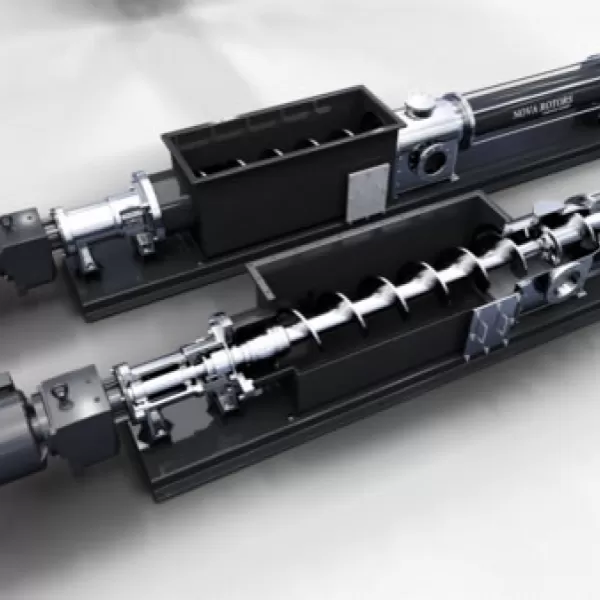
Helical rotor pumps, commonly known as progressive cavity pumps or single-screw pumps, represent one of the most versatile and reliable pumping technologies for handling complex fluids. The operating principle is based on a helical steel rotor that rotates eccentrically inside an elastomeric stator, creating a series of sealed cavities that progressively move from the suction to the discharge end. This mechanism generates a continuous, uniform, pulse-free flow, ideal for viscous fluids containing solid particles or with thixotropic properties.
Nova Rotors' helical rotor pumps stand out for their superior performance in industrial fluid transfer. The progressive cavity technology ensures a constant flow rate independent of operating pressure, self-priming capability that eliminates the need for pre-filling the pipework, and reversible flow that allows the pumping direction to be reversed to clear any blockages. With flow rates up to 420 m³/h and pressures up to 48 bar, these pumps cover a wide range of industrial applications.
Main advantages of helical pumps
Progressive Cavity Pumps and Industrial Grinders: How to Choose the Right Configuration
Introduction
In wastewater treatment, sludge management, and industrial waste handling, selecting the correct pumping solution is essential to ensure operational reliability, reduce maintenance costs, and maintain process efficiency.
Two technologies are commonly used in these applications: progressive cavity pumps and industrial grinders. These technologies are often mistakenly presented as alternatives. In reality, they perform different functions within the process and are frequently used together as part of an integrated system.
Progressive cavity pumps are designed to transfer complex fluids, while industrial grinders are used to reduce the size of solids that could interfere with pumping or downstream equipment.
Solutions such as the Diamond Series and the Terminator Series TG illustrate how pumping and solid size reduction technologies can be combined to optimize plant performance.
Understanding when to use:
- a standard progressive cavity pump
- a grinder installed upstream
- a hopper pump with feeding screw
is essential to design reliable and efficient wastewater and sludge handling systems.
Progressive Cavity Pumps: Operating Principle
Progressive cavity pumps, also known as single-screw pumps, operate using a helical rotor rotating eccentrically inside an elastomer stator.
This configuration creates a sequence of sealed cavities that move progressively from suction to discharge, transporting the fluid smoothly through the pump.
Unlike centrifugal pumps, progressive cavity pumps are positive displacement machines, which means the flow rate remains directly proportional to the rotational speed.
This design offers several advantages for handling difficult fluids.
Key Advantages of Progressive Cavity Pumps
Handling complex fluids
Progressive cavity pumps can manage:
- highly viscous liquids
- sludge with high dry solids content (up to 40%)
- thixotropic fluids
- liquids containing suspended solids.
This makes them widely used in wastewater treatment plants, sludge processing and industrial waste transfer.
Gentle pumping action
The pumping principle generates very low shear stress, preserving the structure of biological sludge flocs and preventing degradation of sensitive products.
Accurate dosing
Because the flow rate is proportional to the rotational speed, these pumps are suitable for precise dosing applications, including polymers, chemicals and additives used in water treatment.
Energy efficiency
Compared with other pumping technologies, progressive cavity pumps often provide lower energy consumption, particularly when handling viscous fluids.
Industrial Grinders: Technology and Function
Industrial grinders are mechanical devices specifically designed to reduce the size of solids contained in wastewater, sludge or liquid waste streams.
Unlike pumps, grinders do not transfer fluid. Their function is to cut, shred or macerate solids before they enter pumping systems or downstream treatment stages.
Industrial grinders such as the Terminator Series TG are commonly installed upstream of pumps to protect equipment and improve process reliability.
It is important to clarify that grinders are not designed to destroy every type of solid material. They are highly effective for:
fibrous materials
wipes and textiles
plastics
organic solids.
However, they are not intended for large stones, metal objects or heavy mineral debris, which require different separation or protection systems.
Key Benefits of Industrial Grinders
Protection of downstream equipment
Grinders prevent damage to pumps, valves and pipelines by reducing the size of solids that could otherwise cause blockages or mechanical damage.
Uniform particle size reduction
The shredding process creates a more homogeneous mixture, improving the efficiency of downstream treatment processes such as filtration, centrifugation and digestion.
Prevention of clogging
Reducing solid size eliminates the formation of bridges or blockages in pipes and pumping systems.
Improved plant reliability
By protecting pumps and pipelines, grinders help reduce unplanned downtime and maintenance interventions.
When to Use Progressive Cavity Pumps
Progressive cavity pumps are the ideal solution when the primary objective is efficient fluid transfer, particularly in the presence of viscous or complex media.
Typical applications include:
pumping thickened or dewatered sludge
transferring viscous liquids
dosing chemicals or polymers
applications requiring constant flow rate
processes where low shear pumping is required.
In these cases, the fluid composition does not typically contain large fibrous materials or debris capable of blocking the pump.
When to Install a Grinder Upstream of the Pump
Industrial grinders become necessary when the fluid contains materials that could interfere with pumping equipment.
Typical examples include:
wipes and textile fibers in municipal wastewater
plastic fragments
organic fibrous material
food processing residues.
Installing a grinder upstream of the pump protects the pumping system and reduces the risk of clogging or mechanical damage.
When to Use Hopper Pumps with Feeding Screw
In some applications the problem is not the size of solids, but rather the difficulty of feeding the pump.
Very dense sludge, semi-solid waste or biomass may not flow easily into a standard pump suction inlet.
In these cases, pumps equipped with hopper and feeding screw systems, such as the DHS Series, provide the most effective solution.
These pumps are designed for materials such as:
thick sludge
dewatered biosolids
organic waste
semi-solid industrial residues.
Many hopper pumps also include stone trap systems that allow heavy materials such as sand or small stones to settle before entering the pumping elements, protecting the rotor and stator from damage.
Integrated Systems in Wastewater Treatment Plants
Modern wastewater treatment plants often use integrated systems combining grinders and progressive cavity pumps.
A typical configuration may include:
Raw wastewater entering the plant
Installation of an industrial grinder to reduce large solids
Progressive cavity pump for transferring sludge or wastewater
Thickening and dewatering processes
Hopper pump for feeding centrifuges or filter presses.
This integrated approach significantly improves plant reliability and operational efficiency.
Why Integrated Pump–Grinder Solutions Are Effective
Combining grinders and progressive cavity pumps offers several advantages:
reduced pump wear
improved pumping efficiency
lower maintenance costs
longer equipment lifetime
fewer system blockages.
By ensuring that solids are properly conditioned before pumping, plants can operate more reliably and with lower operational risk.
Conclusion
Progressive cavity pumps and industrial grinders should not be considered competing technologies.
Instead, they are complementary components within a well-designed fluid handling system.
The correct configuration depends on several factors:
solid content and type
viscosity of the fluid
feeding conditions
presence of abrasive or heavy materials.
A careful analysis of these parameters allows engineers to select the most appropriate combination of technologies to ensure efficient, reliable and long-term plant operation.
Applications in wastewater treatment
The wastewater treatment sector represents the quintessential field of application where helical rotor pumps and industrial grinders are used both individually and in integrated configurations. Civil and industrial treatment plants must handle fluids that vary enormously in terms of composition, viscosity, and solid content, requiring flexible and reliable solutions to ensure round-the-clock operational continuity.
Nova Rotors is a national leader in providing complete wastewater treatment solutions, offering both helical rotor pumps and industrial grinders designed to integrate seamlessly into even the most complex process schemes. The ability to customise configurations based on the specific characteristics of each plant ensures cost optimisation and maximum operational efficiency.
Typical process scheme with pump-grinder integration
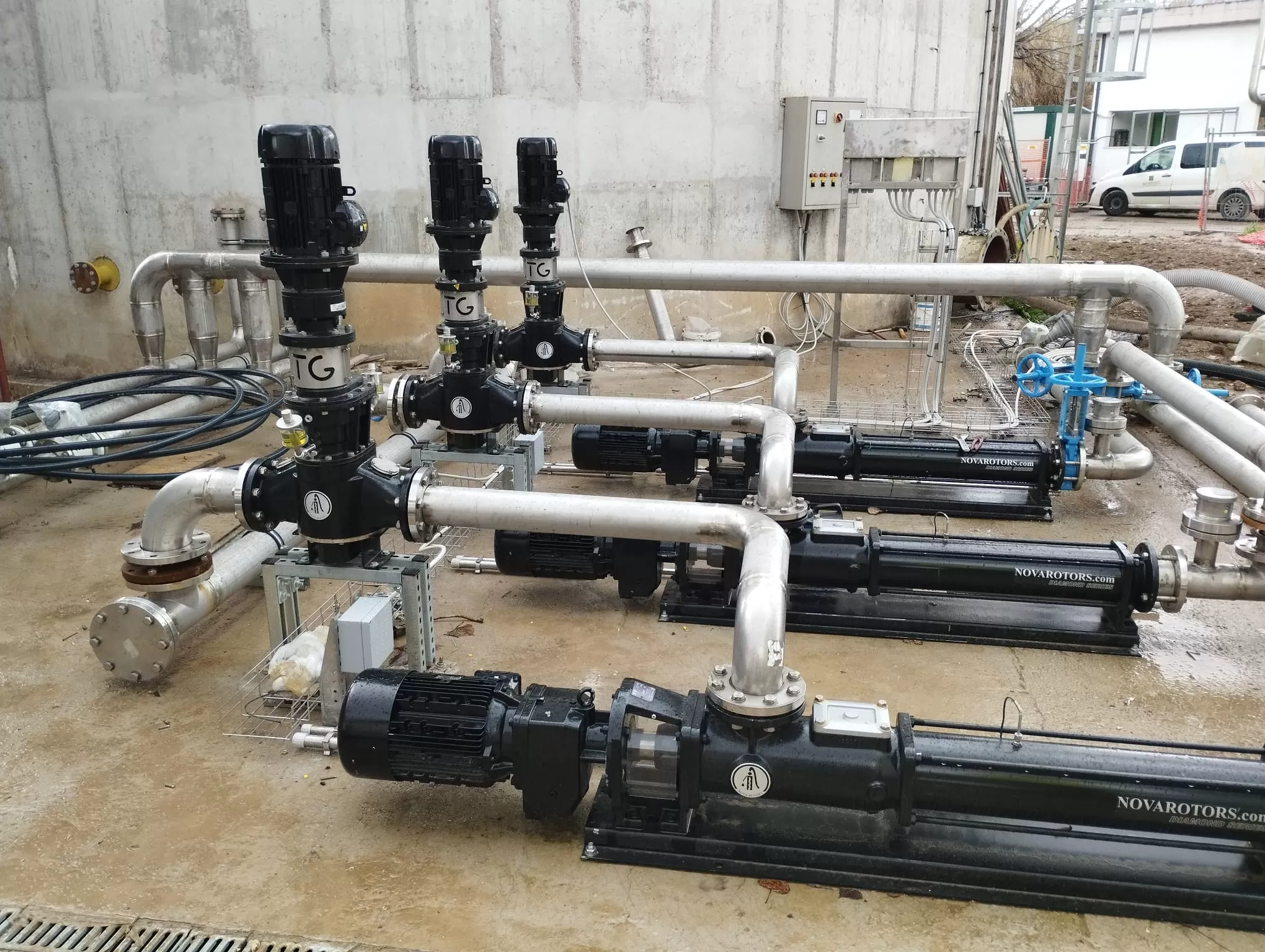
In modern treatment plants, the optimal configuration often involves installing grinders upstream of the pumps to ensure protection and operational continuity. A typical process scheme includes: raw wastewater inlet with installation of a TG grinder for coarse solids reduction, followed by an N series helical rotor pump for lifting to the biological oxidation tanks, then a sludge thickener with an N series pump for transferring thickened sludge, further grinding with a TG unit for sludge containing residual fibres, pumping with an H hopper series for feeding a centrifuge or filter press, and finally an HS or HB series pump for transferring dewatered sludge to a storage silo.
Waste disposal pumps: integrated solutions
Flanged Progressive Cavity Pump with Grinder vs Hopper Pump with Feeding Screw
In applications involving solids, fibers, or debris, engineers often face a design choice between installing an industrial grinder upstream of a standard progressive cavity pump or using a hopper progressive cavity pump with feeding screw and stone trap system.
Both configurations can be effective, but they address different operational challenges.
Solutions such as a standard flanged progressive cavity pump from the Diamond Series combined with an upstream grinder from the Terminator Series TG, or a hopper pump from the DHS Series, are designed for specific process conditions.
Understanding the differences between these configurations is essential for selecting the most reliable system.
Configuration 1: Flanged Progressive Cavity Pump with Upstream Grinder
In this configuration, the grinder is installed upstream of the pump to reduce the size of solids before the fluid enters the pumping elements.
The grinder cuts and macerates fibrous materials that could otherwise wrap around the rotor or block the pump.
This solution is particularly suitable when the fluid contains:
wipes and textiles
plastic fragments
fibrous organic materials
food processing residues.
The grinder protects the pump by ensuring that solids are reduced to a manageable size before pumping.
However, grinders are not designed to handle large stones or heavy mineral debris. In such cases, upstream screening or sediment removal systems may still be required.
This configuration is commonly used in:
municipal wastewater pumping stations
raw sewage transfer
industrial wastewater containing fibrous contaminants.
Configuration 2: Hopper Progressive Cavity Pump with Feeding Screw (DHS Series)
When the main challenge is feeding the pump with very dense or poorly flowing materials, hopper pumps provide a more suitable solution.
Pumps such as the DHS Series are equipped with:
a rectangular hopper
a feeding screw that pushes material toward the rotor–stator assembly
a stone trap zone located at the bottom of the hopper.
In this design, the feeding screw does not extend across the entire hopper base. This creates a collection zone where heavy materials such as stones, gravel or metal fragments can settle.
These materials accumulate at the bottom of the hopper rather than entering the pumping elements.
The hopper typically includes inspection and cleaning doors, allowing operators to periodically remove accumulated debris from the stone trap area.
This configuration is particularly effective for handling:
thick sludge with high solids content
dewatered biosolids
biomass and organic waste
semi-solid industrial residues containing sand or small stones.
Key Differences Between the Two Configurations
The choice between these two solutions depends primarily on the nature of the solids and the flow characteristics of the material.
A grinder + flanged pump system is ideal when the main issue is fibrous contamination, while a hopper pump with stone trap is more suitable when dealing with dense materials containing heavy particles.
In many sludge-handling applications, hopper pumps provide an additional advantage because they ensure consistent feeding of difficult materials that would not naturally flow into a standard suction inlet.
Comparison table: technical selection criteria
| Feature | Flanged PC Pump + Grinder | Hopper Pump (DHS Series) |
|---|---|---|
| Primary function | Solid size reduction before pumping | Feeding and pumping dense materials |
| Best for | Fibrous materials, wipes, plastics | Thick sludge, biomass, semi-solids |
| Protection against stones | Limited | Stone trap inside hopper |
| Feeding capability | Requires fluid flow into suction | Screw feeder pushes material into pump |
| Maintenance | Grinder maintenance required | Periodic cleaning of hopper stone trap |
| Typical applications | Raw sewage, wastewater transfer | Sludge handling, dewatered biosolids |
Material selection and special configurations
Both Nova Rotors helical rotor pumps and industrial grinders are available in multiple material configurations to suit the physico-chemical characteristics of the fluids being processed. Correct material selection is essential to ensure operational longevity and regulatory compliance, particularly in applications involving corrosive, abrasive, or high-temperature fluids.
For helical rotor pumps, pump bodies are available in GG25 cast iron for standard applications, carbon steel for intensive industrial use, AISI 304 stainless steel for moderately corrosive environments, and AISI 316 or special duplex alloys for highly aggressive fluids. Rotors can be supplied in standard steel, hard chrome-plated HCP steel for abrasion resistance, nitrided steel for superior surface hardness, or with ceramic coatings for extremely demanding applications. Elastomeric stators can be selected from NBR (nitrile) for standard use with good resistance to oils and hydrocarbons, EPDM for chemical resistance to strong bases and oxidising agents, FPM (Viton) for high temperatures up to 150°C and resistance to solvents, and food-grade certified NBR for contact with food products.
Special configurations for critical applications
For potentially explosive environments, Nova Rotors supplies both pumps and grinders with ATEX certification in compliance with Directive 94/9/EC, using certified motors and antistatic components. Wastewater treatment pumps and in particular Oil and gas pumps can be equipped with pressurised double mechanical seal systems with a flush arrangement compliant with API Plan standards to prevent environmental contamination. Terminator grinders can be fitted with electrical panels featuring automatic direction reversal in the event of overload — a system that detects blade blockages and instantly reverses the direction of rotation to clear the obstruction, reducing downtime and preventing mechanical damage.
Maintenance and technical support from Nova Rotors
Nova Rotors supports its customers not only during the equipment selection and supply phase, but also provides comprehensive support throughout the entire operational lifecycle through dedicated after-sales service. The immediate availability of original spare parts, qualified technical support, and preventive maintenance programmes ensure maximum plant uptime and reduced production downtime costs.
Helical rotor pumps require periodic maintenance primarily on elastomeric stators, whose operational lifespan ranges from 2,000 to 8,000 hours depending on the characteristics of the fluid being pumped and the operating conditions. The patented pin-type joint of the Diamond series greatly simplifies maintenance operations, allowing rapid replacement of worn components without the need to fully disassemble the pump. Terminator grinders, thanks to the lubricated cartridge seal system fed by a small cup reservoir, require minimal maintenance with significantly longer service intervals compared to other grinding systems on the market.
Predictive maintenance programmes
Nova Rotors offers predictive maintenance programmes that use vibration monitoring, electrical current analysis, and scheduled periodic inspections to anticipate potential issues before they cause plant downtime. This proactive approach is particularly beneficial for treatment plants operating continuously 24/7, where an unexpected shutdown can have significant environmental and economic consequences. The ability to plan maintenance interventions within pre-defined time windows optimises resource management and reduces overall operating costs.
Intelligent integration for maximum efficiency
The comparison between helical rotor pumps and industrial grinders reveals that, in most real-world applications in wastewater treatment and waste disposal, the optimal answer is not an either/or choice between the two technologies, but rather an intelligent integration that harnesses the strengths of each solution. Nova Rotors progressive cavity pumps excel at efficiently transferring complex fluids, ensuring constant flow rates, precise dosing, and the handling of high-viscosity materials. Terminator TG grinders protect plant equipment, optimise downstream processes, and prevent costly downtime caused by blockages.
The ideal configuration typically involves installing grinders upstream of the helical rotor pumps, creating an integrated system in which solids pre-treatment allows the pumps to operate under optimal conditions, extending their operational life and drastically reducing maintenance requirements. This systematic approach, backed by Nova Rotors' thirty years of experience and construction quality certified to ISO 9001:2015 and ISO 45001:2018, represents the most reliable and cost-effective solution for treatment plants and waste processing facilities of every size.
Nova Rotors stands as a strategic partner for designers, plant managers, and operators in the environmental sector, offering not only outstanding products but also specialised technical consultancy for the optimal configuration of pumping and pre-treatment solutions. The availability of a comprehensive range spanning single-screw pumps, industrial grinders, dosing systems, and complementary accessories makes it possible to deliver fully integrated, turnkey solutions precisely sized for specific application requirements. Contacting Nova Rotors experts for personalised consultancy is the first step towards optimising plant performance and reducing operating costs in wastewater treatment and industrial waste management.